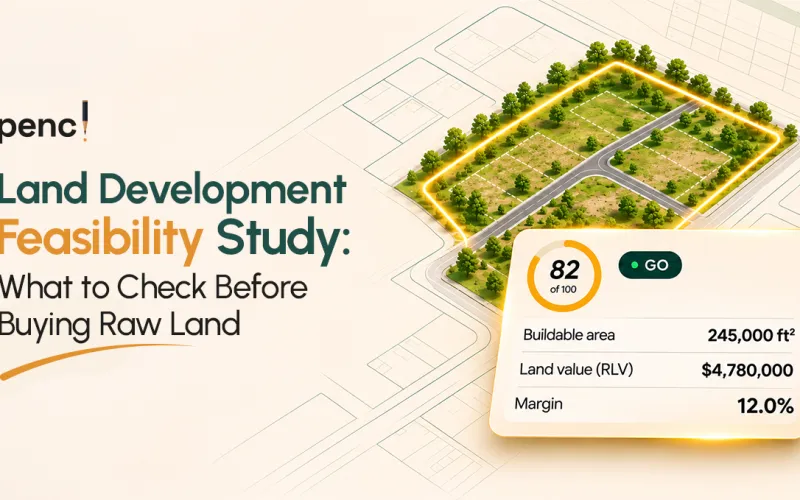
A piece of land isn’t necessarily a profitable investment. The numbers can change quickly once you account for buildable acreage, infrastructure costs, financing, and development restrictions.
A low purchase price does not automatically make a property a good deal. The real question is whether the land can support your development plans and generate an acceptable return. A real estate feasibility study helps answer that question before you commit significant capital. It brings land constraints, development costs, revenue assumptions, and financing requirements into one financial evaluation.
For developers, homebuilders, and land acquisition teams, this process can separate promising opportunities from expensive mistakes. It also helps establish the maximum price worth offering for a property. This guide explains how to evaluate a potential land deal, identify risks, calculate residual land value, and decide whether to proceed.
What Is a Real Estate Feasibility Study?
A real estate feasibility study evaluates whether a proposed property acquisition or development project makes financial and practical sense. It examines the relationship between what a project will cost, what the completed development could generate, and what risks could affect its profitability.
For land acquisition, the analysis typically considers:
- Land acquisition: Purchase price, closing expenses, and related acquisition costs.
- Site yield: How much of the property can support the intended development.
- Development costs: Grading, roads, utilities, drainage, and other infrastructure requirements.
- Regulatory constraints: Zoning, setbacks, environmental restrictions, and approval requirements.
- Financing: Loan terms, interest expenses, equity requirements, and debt obligations.
- Revenue potential: Expected finished-lot sales, property income, or completed development value.
- Investment returns: Project margins, cash flow, and returns relative to invested capital.
A feasibility study connects these factors rather than evaluating them independently. For example, a property might offer substantial acreage at an attractive price. However, floodplain restrictions, drainage requirements, or infrastructure extensions could reduce its usable area and increase its development costs.
The resulting economics may look very different from the original estimate. A thorough evaluation helps identify these issues before they become costly commitments.
Why Developers Need a Feasibility Study Before Buying Land
Land acquisition decisions often involve substantial capital and uncertainties that cannot be resolved through a property listing alone. A feasibility study helps developers make informed decisions in several important areas.
1. Determine Whether the Deal Can Generate an Acceptable Return
The purchase price represents only one part of a development project’s total cost. Developers must also account for construction, infrastructure, professional services, financing, approvals, and other project expenses.
A feasibility model compares these costs against expected revenue. This reveals whether the remaining margin justifies the investment.
2. Identify Constraints That Reduce Developable Acreage
Gross acreage does not necessarily equal usable development area. Roads, setbacks, drainage facilities, open space, floodplains, and other site constraints can reduce the number of lots a developer can deliver.
A land development feasibility study should account for these deductions before calculating potential revenue.
3. Establish a Defensible Land Offer
Developers need a purchase-price limit that reflects project economics, not simply the seller’s asking price. Residual land valuation helps estimate what a developer can afford to pay after accounting for expected revenue, development costs, and the required financial return.
4. Understand Financing Requirements
Financing terms affect project cash flow and profitability. Higher interest rates, additional equity requirements, or longer development timelines can change the economics of an otherwise attractive deal.
Evaluating financing early helps developers understand whether the project remains viable under realistic borrowing conditions.
5. Screen Multiple Opportunities Consistently
Land acquisition teams often evaluate several properties simultaneously. A consistent feasibility process makes it easier to compare opportunities using the same assumptions and decision criteria.
It also helps teams prioritize promising deals and reject weaker opportunities before spending excessive time on them.
How to Conduct a Real Estate Feasibility Study
A practical feasibility process follows a sequence. Each step builds on the previous one, moving from the property’s physical constraints toward its financial potential.
Step 1: Evaluate the Property and Its Constraints
Begin with the property’s location, boundaries, gross acreage, asking price, and intended development. Review the available parcel information and identify the constraints that could affect development.
Important checks include:
- Property boundaries and access.
- Zoning and permitted land uses.
- Required setbacks and development restrictions.
- Floodplain exposure and environmental concerns.
- Drainage requirements and potential detention facilities.
- Utility availability and connection requirements.
- Roads, easements, and other site limitations.
Parcel data and mapping tools can support this initial screening. Floodplain information can also help identify areas requiring further investigation. However, preliminary screening does not replace professional surveys, environmental assessments, engineering studies, or confirmation from the relevant authorities.
Step 2: Estimate the Realistic Site Yield
Next, estimate how much of the property can support the proposed development. Consider a hypothetical 40-acre property intended for residential subdivision. The gross acreage is 40 acres. However, roads, drainage facilities, setbacks, open space, and other constraints may reduce the developable area.
The remaining acreage determines how much land can contribute to the intended lot layout. Do not assume every developable acre will translate directly into finished lots. Road geometry, lot dimensions, zoning rules, and infrastructure requirements also affect the final yield. A realistic lot-count estimate is essential because revenue projections depend heavily on how many saleable lots the project can deliver.
Step 3: Estimate Total Development Costs
Once the potential site yield is established, estimate the costs required to make the project deliverable. Include the land purchase price and other acquisition expenses. Then estimate horizontal development costs, such as grading, roads, utilities, drainage, and related infrastructure.
Also consider professional fees, entitlement costs, permitting, financing expenses, contingency allowances, and other applicable project costs. For raw land, infrastructure can materially change the economics of a subdivision.
A property requiring extensive utility extensions or flood detention improvements may be less attractive than a comparable property with existing infrastructure. Use preliminary estimates for initial screening. Obtain appropriate contractor bids, engineering input, and other professional estimates before making a binding investment decision.
Step 4: Build the Financial Pro Forma
A real estate development pro forma organizes the project’s expected revenue, costs, and financial performance. For a subdivision, revenue might come from selling finished lots. Other development types may rely on rental income, property sales, or different revenue models.
A basic feasibility model should account for:
- Expected revenue.
- Land acquisition and closing costs.
- Site preparation and infrastructure.
- Construction or development expenses.
- Professional fees and approval costs.
- Financing and interest expenses.
- Contingency allowances.
- Projected profit and investment returns.
The model should reflect the project’s intended exit strategy. For example, a developer selling finished lots to homebuilders faces different timing and revenue assumptions than an investor retaining completed properties.
Avoid relying on a single optimistic forecast. Test how changes in costs, revenue, financing, and timing affect the results.
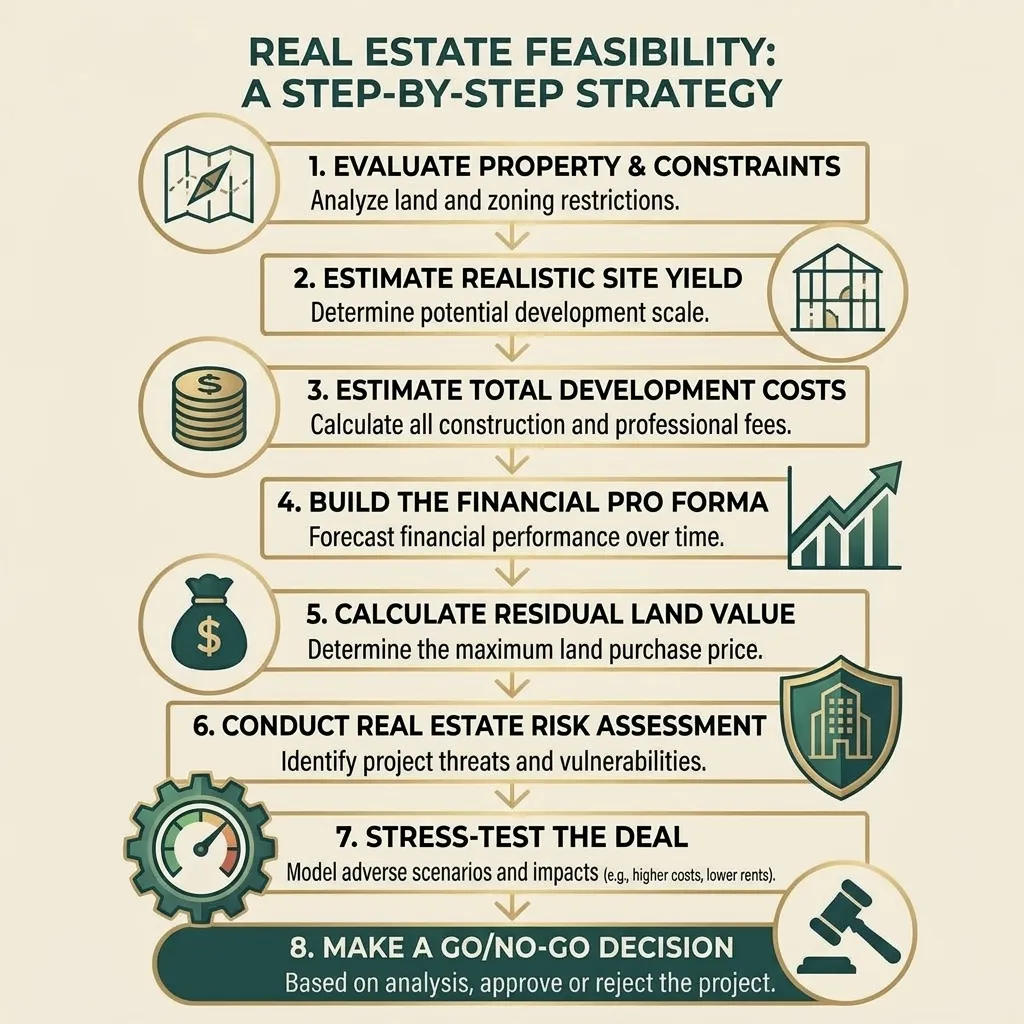
Step 5: Calculate Residual Land Value
Residual land value (RLV) estimates the amount a developer can pay for land while preserving the project’s required financial outcome. The underlying principle is straightforward: start with the development’s expected value and deduct the costs and return requirements that must be covered.
A simplified conceptual formula is:
Residual Land Value = Expected Development Value − Non-Land Project Costs − Required Profit
This simplified expression assumes the required profit is expressed consistently with the other figures. A detailed model may also account for financing, timing, and specific valuation conventions.
Consider a hypothetical project with these assumptions:
| Financial component | Illustrative amount |
| Expected development revenue | $5,000,000 |
| Non-land project costs | $3,200,000 |
| Required profit | $800,000 |
| Residual land value | $1,000,000 |
These figures are illustrative, not market estimates. Actual results depend on the project’s costs, revenue assumptions, financing structure, and required return.
Under these assumptions, the developer’s residual land value is $1 million. If the seller asks $1.3 million, the deal does not meet the modeled profit requirement at that price. The developer could negotiate a lower purchase price, revise the development plan, investigate cost reductions, or reject the opportunity.
Step 6: Conduct a Real Estate Risk Assessment
A property’s base-case financial projections do not tell the whole story. A real estate risk assessment evaluates the uncertainties that could undermine the project’s expected performance. For land development, key risks include:
Environmental risk: Floodplain exposure, potential contamination, wetlands, or other environmental constraints may require further investigation.
Zoning and entitlement risk: Proposed uses, density, lot configurations, or development approvals may differ from initial assumptions.
Infrastructure risk: Utility extensions, road improvements, grading, and drainage facilities may cost more than anticipated.
Financial risk: Higher interest rates, tighter lending terms, or increased equity requirements can weaken project returns.
Market risk: Lower selling prices, slower absorption, or weaker demand can reduce expected revenue.
Schedule risk: Delayed approvals, construction setbacks, or infrastructure work can extend the holding period and increase financing costs.
Property risk assessment should connect each identified risk to its potential financial impact. For example, a drainage requirement may reduce usable acreage while increasing infrastructure expenses. Both effects can reduce residual land value. Where possible, quantify these impacts and incorporate them into the feasibility model.
Step 7: Stress-Test the Deal
A project may appear viable under favorable assumptions but become unprofitable when conditions change. Stress-testing helps determine how much uncertainty the deal can withstand.
Model scenarios such as:
- Higher construction and infrastructure costs.
- Lower finished-lot prices or rental income.
- Increased borrowing costs.
- Delayed approvals or project completion.
- Reduced site yield.
- Slower sales or leasing.
The research framework for Pencl highlights testing interest-rate increases of 100 basis points or more and six-month construction delays. These are useful example scenarios, not universal requirements for every project.
Compare the resulting returns, cash requirements, and residual land values. Identify which assumptions have the greatest effect on the outcome. If a small cost increase eliminates the projected profit, the deal has little room for error. If the project remains viable across several realistic downside scenarios, the investment case may be more resilient.
Step 8: Make a Go/No-Go Decision
The final step is to bring the analysis together and determine whether the property merits further investment. A practical decision framework includes three outcomes.
Go: The project meets the required financial criteria, and major constraints appear manageable. Proceed with the next stage of due diligence.
Renegotiate: The project could work at a lower purchase price or with a revised development plan. Use the feasibility model to establish revised acquisition terms.
No-go: The project fails to meet the required financial criteria, or significant risks undermine its viability. Reject the deal or reconsider it only if material assumptions change.
A Go/No-Go decision is an initial investment-screening result, not a guarantee of profitability. Final acquisition decisions still require appropriate legal, financial, engineering, environmental, and regulatory due diligence.
Which Metrics Matter Most in a Land Feasibility Study?
The right metrics depend on the development type, investment strategy, and financing structure. However, several indicators help developers evaluate whether a potential acquisition meets their objectives.
| Metric | What It Helps Evaluate |
| Developable acreage | How much of the site can support the intended project |
| Estimated lot yield | How many lots the development may deliver |
| Total development cost | The expected cost of acquiring and developing the property |
| Residual land value | The maximum land price supported by modeled project economics |
| Development profit margin | The relationship between projected profit and the chosen revenue or cost basis |
| Yield on Cost (YoC) | Stabilized property income relative to total development cost, where applicable |
| Internal Rate of Return (IRR) | The modeled annualized return based on the timing of cash flows |
| Debt Service Coverage Ratio (DSCR) | Whether operating income can cover scheduled debt service |
| Equity Multiple | Total equity distributions relative to contributed equity |
| Sensitivity analysis | How changes in key assumptions affect the investment outcome |
Not every metric applies to every project. For example, DSCR and stabilized Yield on Cost are particularly relevant to income-producing developments. A land subdivision for finished-lot sales may emphasize lot yield, development costs, sales assumptions, profit margin, and residual land value. Evaluate metrics together rather than treating a single number as proof of feasibility.
Can Feasibility Software Make Land Acquisition Faster?
Traditional feasibility analysis can involve spreadsheets, parcel research, financial modeling, and repeated manual calculations. That process becomes harder to manage when acquisition teams evaluate multiple properties with different constraints and assumptions.
Feasibility software can automate the initial screening process by bringing key inputs and financial outputs into a consistent workflow. Pencl is a lightweight land deal underwriting and feasibility platform for developers, homebuilders, land acquisition directors, and land brokers.
Its documented workflow includes several capabilities:
- Parcel screening: Regrid integration supports parcel boundary lookup and property information.
- Floodplain screening: FEMA flood map integration supports preliminary flood-zone identification.
- Site deductions: Account for unusable acreage when estimating development potential.
- Automated feasibility: Generate preliminary Go/No-Go assessments from the modeled inputs.
- Residual land valuation: Evaluate the land price supported by the project’s assumptions.
- Pro forma generation: Organize financial projections for deal evaluation.
- Lender-ready reporting: Generate pitch decks and related financial deliverables.
The intended workflow is straightforward: enter the acreage, target lot count, purchase price, financing assumptions, and relevant site deductions. Review the resulting feasibility analysis, then export the financial deliverables.
This approach helps acquisition teams screen opportunities more consistently and prioritize deals for deeper investigation. It does not eliminate the need for professional judgment. Results largely depend on the quality of input and the completeness of the underlying due diligence.
Common Mistakes to Avoid When Evaluating Land
Even a detailed feasibility model can produce misleading results when its assumptions are weak. A disciplined process addresses these issues before the acquisition moves too far forward. Watch for these common mistakes:
- Using gross acreage as developable acreage. Site constraints can reduce usable land and change the expected lot count.
- Underestimating horizontal development costs. Roads, drainage, grading, and utility extensions can materially affect project economics.
- Accepting optimistic revenue assumptions. Projected sales prices and absorption rates should reflect defensible market evidence.
- Ignoring financing and holding costs. Delays can increase interest expenses and postpone revenue.
- Skipping environmental and regulatory screening. Potential restrictions can affect both development capacity and project costs.
- Relying on a single scenario. A base-case forecast does not show how the project performs under adverse conditions.
- Treating preliminary results as final approval. Initial screening should guide further investigation, not replace it.
Final Thoughts: Evaluate the Numbers Before You Buy
A promising land deal must do more than look attractive or offer substantial acreage at a reasonable price. It must support a realistic development plan, accommodate its infrastructure requirements, and meet your financial objectives after accounting for costs and risks.
A structured real estate feasibility study brings these factors together. It helps estimate site yield, model project economics, calculate residual land value, and identify the conditions that could change an acquisition decision.
For developers evaluating multiple opportunities, a repeatable screening process can make early decisions faster and more consistent. Explore Pencl’s land feasibility platform to learn how automated feasibility analysis, residual land valuation, pro formas, and lender-ready reporting can support your acquisition workflow.
Frequently Asked Questions
What is a real estate feasibility study?
A real estate feasibility study evaluates whether a proposed acquisition or development project is financially and practically viable. It considers site constraints, development costs, expected revenue, financing, and investment returns.
What is included in a land development feasibility study?
A land development feasibility study typically examines property boundaries, zoning, developable acreage, lot yield, infrastructure costs, environmental constraints, financing, projected revenue, and expected profitability.
How do you know if a land deal pencils out?
Estimate the realistic development yield, calculate total project costs, forecast revenue, and evaluate expected returns. Then calculate residual land value and stress-test the assumptions. The deal pencils out when it meets your financial criteria under defensible assumptions.
What is residual land value in real estate?
Residual land value is the amount a developer can pay for land after accounting for expected development value, applicable project costs, and the required financial return. It helps establish a defensible acquisition price.
What is the difference between feasibility analysis and property risk assessment?
Feasibility analysis evaluates whether a project makes financial and practical sense. Property risk assessment identifies uncertainties that could affect its costs, development potential, timeline, or returns. Both contribute to an informed acquisition decision.
Why is floodplain screening important before buying land?
Floodplain screening can identify potential constraints that affect developable acreage, drainage requirements, infrastructure costs, and project design. Preliminary screening should be followed by appropriate professional verification and site-specific due diligence.
Can feasibility software replace a professional feasibility study?
Feasibility software can accelerate initial screening, financial modeling, and reporting. However, it cannot replace all professional engineering, environmental, legal, market, and regulatory investigations required for a specific acquisition.
When should a developer conduct a feasibility study?
Conduct preliminary feasibility analysis before committing to a land purchase. Update the model as better information becomes available, including engineering estimates, approval requirements, financing terms, and market evidence.